Wednesday, 5 December 2012

Towards Kirinyaga

Fruit Seller near Chuka town.
 Check out the size of the avocados  to the right above the bananas.
Kirinyaga is the Kikuyu name for Mount Kenya, a mountain that is regarded as sacred by the people that live around it. It is where the great god Ngai lives. I was told that there used to be snow on the top of Kirinyaga all year round but now it is only there for the few cold months of the year.  All around the base of this 5,200m high mountain live different, but related, tribal groups, each one with there own language. There are nearly 70 different languages spoken in Kenya, and my attempt to learn Swahili - the language chosen at independence as the national language - makes little inroad when visiting a rural church where services are conducted in the local language. 

 So I find myself sitting in Miramene Church of Kianjogu Parish, Imenti South Presbytery taking part in a service in which 4 languages are used: intimations, bizzarely, were in English; all hymns and much of the service was in Kimeru; I spoke in Kiswahili and the visiting preacher who didn't know Kimeru spoke in Kikuyu with smatterings of Kiswahili thrown in for good measure! 

On arriving in Kianjogu, after a 3 hour journey from Nairobi we were treated to a breakfast of tea, arrowroot, sweet potato and boiled eggs. And after the service there was lunch for the hundreds who turned up for the ordination of the young man we had gone to support. In fact, hardly anything happens without food being served in Kenya. In this area in particular it is a sign of hospitality and a sharing of the abundance of food which grows so readily.
Matumbo- The Kenyan equivalent of Haggis! 

Yields are very good due to the high altitude and there was more than one stop on the way back to buy fruit, rice and other local produce.

My cultural learning continued the following week when I got to try matumbo which is stomach stuffed with meat and then roasted. A bit like a cross between black pudding, haggis and beef. It was accompanied by African Sausage - a conglomerate of animal parts as far as I could tell ... and washed down with milky sweet tea. Yum!!

Friday, 16 November 2012

What if....?

PCEA Kahawa Farmers Congregation
While sitting through a 4 hour service at PCEA Kahawa Farmers I began thinking about the differences between the Church of Scotland (CoS) and the Presbyterian Church in East Africa (PCEA).  And not just the differences - but the differences that the differences make.  The 4 hour Sunday morning service was a Commissioning Service which takes place each year.  A few weeks ago all church members gathered at the home of their own district elder (there are 27 districts in the parish) and elected people to serve as deacons and leaders for the next year.  Likewise, new Kirk Session officials were elected from the elders.  After election there is a 1 day training for all leaders. Deacons serve for a period of 3 years and with a staggered system of some new deacons being elected each year.    Kirk Session officials serve for 1 year so there is a constant rotation between elders.  The upshot of this is that many more people feel they have a stake in the church - there were over 140 people standing at the front of the church being commissioned for service.  More people than in many Church of Scotland congregations!

And its not just the leaders that rotate service.  Ministers themselves are sent to a new charge every 5 years on the basis that those who are effective can share their gifts while congregations are spared a long-time with a minister who is not so effective!  It is the PCEA equivalent of '121' CoS Head Office that decides where the next posting is to be.  The individual congregation has no right of call. This has a very clear impact - the laity is much stronger in PCEA churches.  Services are led by the laity often with the minister only preaching the sermon and celebrating sacraments.  Pastoral care is much more embedded within districts with a strong network of support for those who are sick and bereaved.

The attitude toward the youth is also refreshing.  In PCEA Kahawa Farmers there is a designated Youth Elder who, with a church paid Youth Pastor, oversees the running of the Youth Church.  No arguments about the likes and dislikes of a separate service for the youth which I have heard in so many CoS churches.  Just take a look at their website and you will get an idea of how vibrant this congregation of over 200+ young people are.  These young people lead the services, pray, praise, preach - the whole lot.  I am constantly amazed by the spiritual maturity of many of them.  And then when they reach 26 they transfer over to the adult congregation where they are welcomed and given a full role to play.

It is a group of young people from PCEA Kahawa Farmers Youth Church that now regularly go into the local prison and spend time with the young people each week, talking with them and playing sports.

I wonder if there are a few things we can learn from the way they do things in the church in Kenya?

Scottish Safari

New bridge over Bracklinn Falls, Callander
Just back from 3 weeks in Scotland visiting various churches and Presbyteries and talking about my work with prisons in Kenya.  I enjoyed some lovely Autumn weather and the colours of the trees were stunning especially on the Crags in Callander where we lived for 10 years. Despite the busy schedule which took me from one side of the country to another and back again I managed a walk up to the Bracklinn Falls and the site of the new bridge with my friend, Gail.  The original bridge was washed away in a huge flood a few years ago and it was great to be able to cross the falls once again and walk up into the hills.
Celtic Cross at the Bield bathed in Autumnal light.

The trip ended in the peace and quiet of the Bield in Perthshire, a retreat centre which I have used often over the last 10 years.  I gathered there with the Trustees of the Prison Throughcare Trust which is being set up to help coordinate and support my work in Kenya.  It was good to share a time together in such a beautiful setting.


Balmerino Abbey
In between time I visited my home church in Callander and enjoyed a happy reunion with the congregation of St Andrew's, Boness over a soup and sandwich lunch.  Other visits took me from the quietness of Balfron to the bustle of Ferguslie Park in Paisley.  And while visiting Wormit Parish Church in Fife Rev Jim Connelly showed me the hidden secret of Balmerino Abbey, once a huge complex on a pilgrimage route between Iona and St Andrews. Dunipace provided a very warm welcome and visits to Stirling and Falkirk Presbyteries provided an opportunity to touch base with many friends and colleagues.

As I left Scotland an 'artic blast' was getting ready to hit the country. I stepped off the plane in Nairobi to a balmy 25 degrees, to Jacaranda trees in bloom and to a husband and son who were glad to have Mum back.

Thursday, 10 May 2012

Profit out of Peanuts

Roasting peanuts over a jiko
How to make ends meet?  One of the ways in which Philemon Foundation helps ex-offenders is by giving loans for business start-up or growth.  One of our clients, Anne (name changed), is a single mother of two who lives in one of the townships of Nairobi.  She recently received a small loan to help grow her peanut roasting and banana selling business.  I met up with her at the Kibera Probation Office in Nairobi and asked her about how she runs her small business.   Anne has no premises - she walks around 'hawking' her wares looking for the best places to sell.  In the morning she goes and buys fresh supplies of whatever she needs that day.  The bananas  are bought in bunches and then sold singly at a profit.  At the beginning of the week she prepares a few days supply of roast peanuts.  These are put into a pan over a jiko and roasted with salt for flavouring.  Peanuts are a good, she tells me, because everyone eats them for snacks.  After roasting she wraps them in two sizes of paper cones and sells for either Ksh5 (about 3p) or Ksh 10 (about 6p).  She also prepares breakfast for 20 builders on a nearby building site.  The breakfast consists of tea, chapati and a porridge made with finger millet and a good dose of sugar.  Once the building is complete in a few months time she will have to look for something else but in the meantime she is trying to increase the amount of peanuts she sells.  She also has a sewing machine and from time to time gets orders of a school uniform - but she prefers the peanut and banana selling as this brings in a daily income.  Anne thinks carefully about what are the best things to buy and sell.  She watches people's behaviour and keenly observes what they regard as necessities and what they stop spending money on when times are hard.  She hopes with the extra capital she can improve her life and that of her children.  I hope so too! 


Thursday, 12 April 2012

From East to West

I've been here 6 months so thought I had better start some serious blogging.  And having just completed a mammoth journey which took me from Nairobi to Mombasa on the east coast and then to Homa Bay (near Kiisi) on Lake Victoria in the west, I thought this was a good time to start!
 I travelled with Ben, the Field Coordinator for Philemon Foundation in order to meet each of our Regional Coordinators in their place of work.  We also visited prisons and probation departments with whom we work closely for the resettlement and reintegration of prisoners.  And finally, ex-prisoners themselves who belong to 'Phileba' economic/spiritual empowerment groups.

Part 1 of the journey took us from Nairobi to Mombasa by overnight coach disgorging us onto the hot sticky streets at 6am.  We were met by people from the local church that supports Philemon work in the area and by the Regional Coordinator who is also a member of the church, Mount Zion Praise Chapel (an amazing story in itself but that is for another time).   After some catching up and a delicious Swahili curry we went off to the Probation office to meet the staff there and look at how we can work more closely with them.  We were rewarded with the offer of office space which was very welcome given the few resources with which we work.  Then a meeting at Milele Hotel - a beach front conference centre owned and run by the Presbyterian Church of East Africa!   (Milele means 'forever/eternity' in Kiswahili).

Tom Odoyo (Regional Co-ordinator Coast) & Sheena Orr
- in our open air office at Mombasa!
They really know how to do things here.  We tried to work as the wind whipped up our papers and the Indian Ocean beckoned a few feet away.  But work we did resisting all temptation to dive in the cool waters.

In each of the 5 regions where we work we have Prison Permits to visit 3 prisons so this was an opportunity to pay courtesy calls to the Officers in Charge.  At one of the prisons we had a happy reunion with one person who had been transferred from the Nairobi area and was happy to find we were also working in the Coast area as well.  Meetings complete we prepared ourself for the return journey which thankfully went smoothly.
 (There are so many accidents on the Mombasa Highway
 that you really do feel a palpable sense of relief
 when you step of the bus all in one piece at the other end).


Part 2 of the journey took us on a huge circular journey NW from
Sheena with some members of the
 Philemon ex-prisoner self-help group.
Nairobi down the escarpment and then via Narok across Masai plains and the Rift Valley.  Just passed Narok we stopped at Bomet where one of the Regional Coordinators is placed and caught up with one of the ex-prisoner groups in the area.  Then to the local prison before heading off to Homa Bay on the shores of Lake Victoria (the small dot west of Kiisi on the map).  An early start allowed me to get an hours birding in before doing our round of meetings here.  In each place we were keen to explain our approach to Throughcare - getting to know prisoners before they are released and supporting them when they are released.  There is a huge gap here in this aspect of care in Kenya and yet no other organisations have such a joined up way of doing things so people are keen to work with with us and hear what we are doing.    On the third day of our travels we set off in the early morning mist to travel along the lakeshore road up towards Kakamega - a provincial town nestling in the hills.   Here we were taken further into the hills until we came to Hamisi Probation Office where we met with another group of ex-prisoners.   Each of them had inspiring stories about the way the group had organised a 'merry-go-round' system where each member got a lump sum in turn to invest in a small business.  Now that they have each got a little income they are planning a group project on a much bigger scale.  They also meet weekly for fellowship and teaching from the Philemon Regional Coordinator (a trained Chaplain).

After a visit to Kakamega Prison we started the  8 hour journey back to Nairobi through Nakuru and Naivasha.  And so we arrived safely back.  I now have a much better understanding of what Philemon does in each of the areas and was inspired by the individuals I met who, with the support of Philemon, were trying to get their lives back together.

Saturday, 19 November 2011

You know you are in Kenya when...

...there are Maasai guarding your gate
...you can buy 18 quail eggs for £2 in the supermarket
...there is no power in the office two mornings in a row
...you come back to find traditional medicine drying on the driveway
...there is no internet connection in the office
...you spend 9 hours a week learning Swahili
...the songs you sing in church sound different
...the matatu (a minibus which transports people) behind you gets fed up waiting in the queue and goes head on into the oncoming traffic
...the pavements are made of earth
...you are sitting out in the garden in 30 degrees heat at lunchtime on Saturday!

Been here 2 weeks - rapidly getting into the swing of things - making lots of friends.  Learning to read and speak Swahili.  Getting to know colleagues at Philemon (more in next post).  Feel very privileged to be here and being able to work with prison and throughcare ministry.

Thursday, 8 September 2011

March of Hope

What are you doing on September 24th?  That's the day I will be Walking/Cycling between Saughton Prison in Edinburgh to Polmont Young Offenders Institute near Falkirk.  A 20+mile journey along the Union Canal.  Its to raise money for the work of the Philemon Foundation in Kenya. Philemon UK supporters will be doing a March of Hope in London on the same day. Philemon works with prisoners and ex-offenders in a variety of practical and supportive ways which helps to transform lives.  It also helps people to reintegrate into their communities.  This is the organisation I spent time with when I was out in August and will return to work with them in November this year.  Please support the great ministry they do by clicking on the button below!


Friday, 19 August 2011

Introducing Kahawa Farmers

Exterior KF PCEA by dhscott50
Rev Alfred Kanga, Rev Douglas Njoka, Sheena Orr, Peter Maura, Rev Donald Scott.


Kahawa Farmers is the name of the congregation that I have been given as my home congregation by Nairobi North Presbytery. During the last 3 weeks I have been worshipping with them and getting to know some of the elders including Peter Maura, the Session Clerk. Rev Douglas Njoka is the minister - a lovely, gracious man. He knows Edinburgh having studied at New College for a year in the 1980's. The Presbytery Clerk, Rev Kanga has been very helpful in releasing me to work with in prison ministry. And Rev Donald Scott from my home Presbytery of Falkirk came out to check I would be in good hands!

The church is situated 15 kms to the north of the city and is in a coffee (kahawa) growing area and just 1 km away from Kamiti Maximum security prison. Three services are held on Sunday - An English service 8.30-10.00; a Swahili Service - although most of it is actually in Kikuyu - from 10-12.30 ish...... there is also a youth service going on concurrently with 100+ young people in addition to the very well attended Sunday School. I have been impressed by the involvement of people in all aspects of the service particularly young people who get up and lead worship as well as extempore prayers. I have been very warmly welcomed and look forward with great anticipation to making this my spiritual home for the next few years.

Mombasa to Mara

Angus, Euan, Niall and Aidan 
relaxing
 in the Indian Ocean
Arrived in Kenya in early July for 3 weeks holiday with the whole family plus Angus, a friend of Aidan's, who was coming out to see where Aidan is going to be living and going to school.  After a few days in Nairobi we headed down to the coast.  What we thought was going to be a 6 hour journey ended up being 10.5 hours on a very busy road.  All the containers arriving at the port in Mombasa are put on lorries which then c...r...a...w...l along the road between Mombasa and Nairobi and back.  The whole journey is stop-start as cars try to overtake on a single carriageway.  It is not uncommon to be forced off the road as a 'matatu' - mad minibus - comes tearing towards you with lights flashing.  The road drops from 6,000ft in Nairobi to sea level at Mombasa with lots of changes of scenery as you go down the escarpment.  The temperature also heats up - rather welcome as being the middle of winter in the southern hemisphere it can be very chilly in Nairobi. In fact we have rarely had a sunny day since arriving. One is not surprised to learn that  Nairobi was originally chosen as a place to settle because its weather is like Britain's!

Zebra in sight
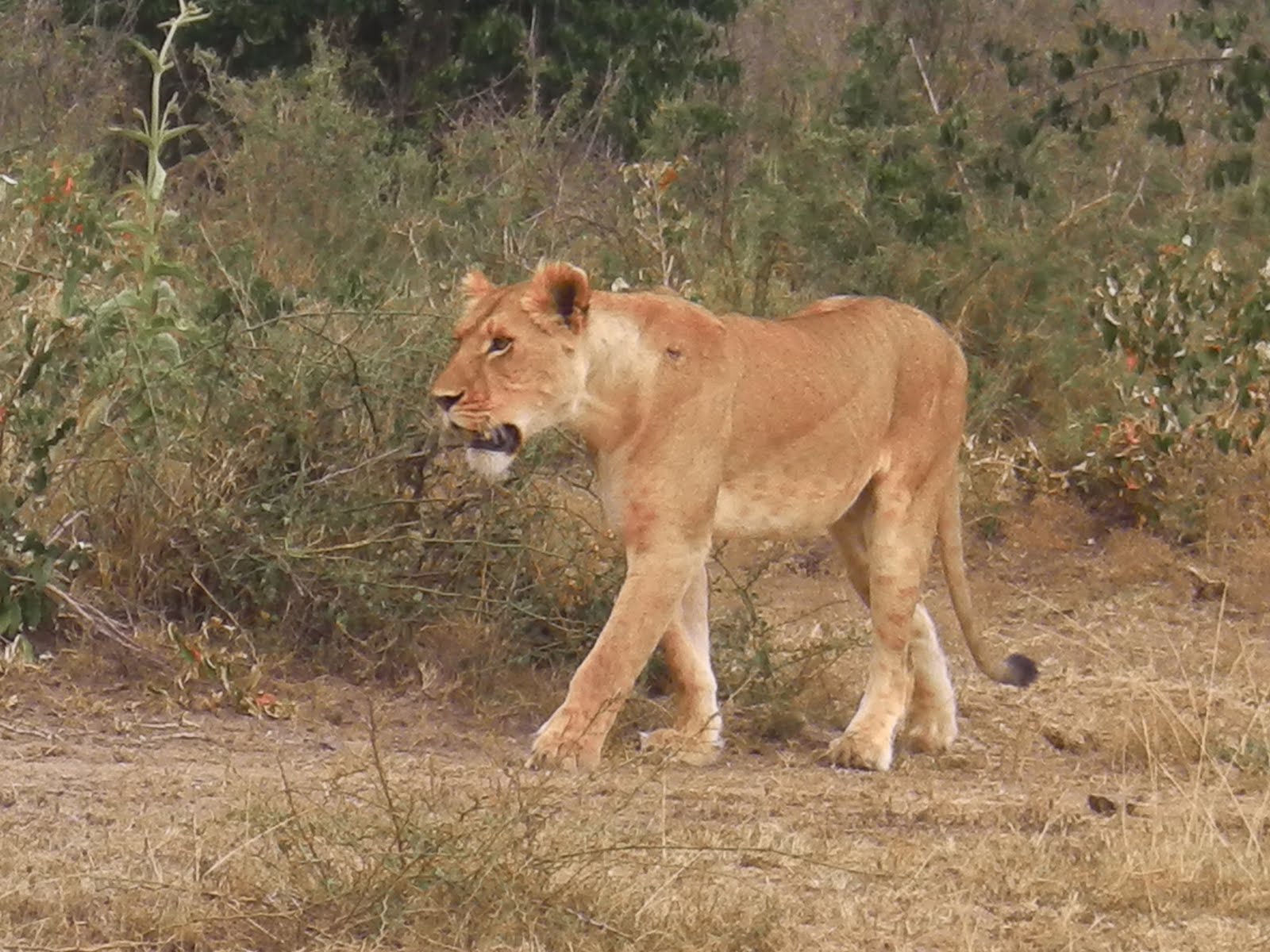
A week later we went to the Masai Mara where we had an amazing time seeing animals.  Herds of buffalo, zebra, giraffe, elephant, antelope, zebra.  Warthog with their funny little tails in the air, hyenas, leopard, thousands of vultures circling over the Mara as they prepared to gorge on yet another carcass of wildebeest or zebra that didn't make it across the river.  And the most amazing thing - a lion kill just 4 metres away.  We all watched with bated breath as a lion crouched behind a bush - we then realised it was eyeing up a young zebra that was walking past with its mother totally unaware of the lions presence. We watched with horror and awe as the female lion sprung out grabbing the young zebra around the neck and dragging it to the ground.  The mother zebra was absolutely distraught standing for a good 5 minutes staring and braying loudly as she watched the lion drag her baby away.  I wasn't dry eyed either. I know its nature but to see something so powerful happen in front of your eyes is rather overwhelming. No photo of the kill I'm afraid as I was too stunned to take pictures!  

 At night we returned to the 'bush camp' - luxury tents complete with beds and solar lighting.  The camp was on the edge of the escarpment above the Mara with amazing view over the plains below.  A trip of a lifetime.

Wednesday, 6 July 2011

Bag packing

Packing suitcases is always a big challenge - what do you put in?  what do you leave behind?  what is indispensable?  what isn't really needed?  I am always intrigued when I return from a trip to see what never got used. I suppose I am one of those people who puts things in 'just in case'.  But as I leave for Kenya on this trip I am having to think about three different types of journey - and I am not sure whether the task is made any easier by the fact that I have just discovered that we can take two 23kg suitcases per person. O the choice of what to take and what to leave! Most immediately there is the family holiday to consider.  That part is easy - swimsuit, mask and snorkel, cotton clothes, sandals, bird book, binoculars (yes I am a birdwatcher!) .  But then there is my 4 week secondment to the Presbyterian Church of East Africa and to Philemon Kenya.  Will I need any books to help prepare sermons?  Better take Common Order me thinks.  It's a funny feeling leaving my library behind. I have been so immersed in books over the past few years and now I will be standing in a foreign country, miles from Scotland with nothing but the Bible and all I have ingested through years of study and placements.  Then there is the actual move out to Kenya which I will be making later in the year.  What can I take out now that I might need later?  My youngest son, Aidan, will be starting school in Nairobi in August and he is packing all his worldly goods into 2 suitcases.  What baggage we accrue as we go through life.  In fact one of the good things about moving is that you get a chance to throw out all the junk that you never use or wear.  Preparing for moving to Kenya is also an opportunity to look at what I will find most useful in all the training I have undertaken and what bits I may end up leaving aside.  As circumstances change different skills and attitudes are needed at different times.  This can be unsettling but the lure of a new place, new people, new situations always outweighs any reservations I might have.  I have found it is the same with my faith as well.  As new questions arise, as I face new situations, as I meet others and listen to their point of view I have a chance to reflect on what baggage I have been carrying around from the past, what is useful and what needs thrown out. So my cases are packed - but only for the journey. Its not good to pack things away for too long.

Thursday, 23 June 2011

Wot? No guidebook?

When I started training for the ministry I knew that it had to be a step at a time.  I had no big vision of where God was calling me.  I had no certain answers as to what God was calling me to.  All I knew was that God had called me to follow a certain path and that my task was to follow obediently.  I had vague notions about being on the edge - and working in team.  But that was about it.  Now as I look back over the past few years I see how what seemed disparate strands have all come together in a rich tapestry of experience infused with a passion for ministry to people affected by imprisonment - inside and out, themselves and their families.  There is no guidebook for this sort of work.  It is something that  grows organically - through relationship, through opportunities - making them and responding to them, through praying and listening to that still small voice which suggests ridiculous things.

So here I am with whole new vistas opening up in front as I stand amazed at the way, without any orchestration on my part, so many things, people, situations, events ...  are falling into place as I move towards ordination.  And there may be no guidebook on what lies ahead but I know a good guide...